
Table of Contents
Objective:
To help tourism boards, destination marketing organisations and regional visitor bureaus coordinate useful content, partner visibility and search demand so their location shows up wherever travellers plan trips, from Google results to AI assistants.
A couple in Melbourne is planning a week in Rajasthan. They ask an AI assistant for a seven-day itinerary with heritage stays, search Google for “best time to visit Udaipur” and watch two travel videos. Across that whole journey, the official tourism board may never appear once. Hotel chains, OTAs and travel bloggers answer every question instead.
Fact: International tourist arrivals reached an estimated 1.52 billion in 2025, up 4% on 2024 (UN Tourism, World Tourism Barometer). Travel and tourism also contributed a record US$11.6 trillion, or 9.8% of global GDP, in 2025 (WTTC Economic Impact Research). The demand is real. The question is who captures it online.
Destination organisations sit in a unique position. They rarely sell rooms or tours directly, yet they hold the widest view of a place: its seasons, its events, its neighbourhoods and the hundreds of local businesses that make a trip work. When that knowledge is organised around real search demand and shared with partners, the destination becomes the most trusted source about itself.
At White Hat SEO Guru, we see the same pattern across tourism projects. The destinations that win online are not the ones that publish the most. They are the ones that coordinate best.
Want Your Destination to Show Up Where Travellers Plan?
Key Takeaways
- Destination marketing online works best when content, partner visibility and search demand are managed as one system, not three separate jobs.
- Travellers are moving faster than destinations: 54% have used AI to plan travel, yet only 22% of DMOs offer AI trip planning on their websites.
- Search demand data should decide what a destination publishes, when it publishes and which partners it features.
- Partner listings, events and local businesses give DMO websites the depth and freshness that Google and LLMs reward.
- Measure success by visibility across Google, AI answers and partner referrals, not website sessions alone.
What Is Destination Marketing Online?
A destination marketing organisation (DMO) is the body that promotes a city, region or country to visitors. It may be a national tourism board, a state agency or a convention and visitors bureau. Destination marketing online is how that body builds visibility across search engines, AI platforms, maps, social channels and partner websites.
The role has changed. A decade ago, the DMO website was a digital brochure. Today it needs to work as the central knowledge hub for the place, answering travellers’ real questions and sending them to local businesses that can serve them. That matters well beyond hotels. Destinations International notes that visitor spending generates additional business sales equal to nearly 60% of the direct spend.
Why Destination Visibility Is Harder in 2026
Travellers have more ways to plan than ever, and fewer of those paths lead to official tourism websites. Three shifts stand out.
AI Answers Are Replacing Clicks
Ahrefs research found that, as of December 2025, an AI Overview cut the click-through rate of the top-ranking page by about 58%. Broad queries like “things to do in Lisbon” are now often answered on the results page. A destination has to be the source those answers cite, not just a blue link below them.
Travellers Plan with AI Before They Search
Phocuswright reports that more than half of US leisure travellers now use AI to plan, book or navigate trips. A September 2026 study by Mindtrip, Sabre, Sojern and MMGY Travel Intelligence found that 40% of travellers have discovered a destination through AI, and 29% have changed plans based on an AI recommendation.
Partners and OTAs Chase the Same Queries
Hotels, OTAs, tour marketplaces and publishers all target destination keywords. Without coordination, a DMO ends up competing with its own partners instead of lifting them, and the traveller sees a scattered picture of the place.
The AI Readiness Gap at a Glance
| Metric | Share | Group |
| Have used AI to plan travel | 54% | Travellers |
| Intend to use AI for future trips | 75% | Travellers |
| Would use an AI trip planner on a destination website | 63% | Travellers |
| Less likely to use a destination site without AI features | 25% | Travellers |
| Have a documented AI strategy | 26% | DMOs |
| Offer AI trip planning on their website | 22% | DMOs |
Source: Mindtrip, Sabre, Sojern and MMGY Travel Intelligence, September 2026.
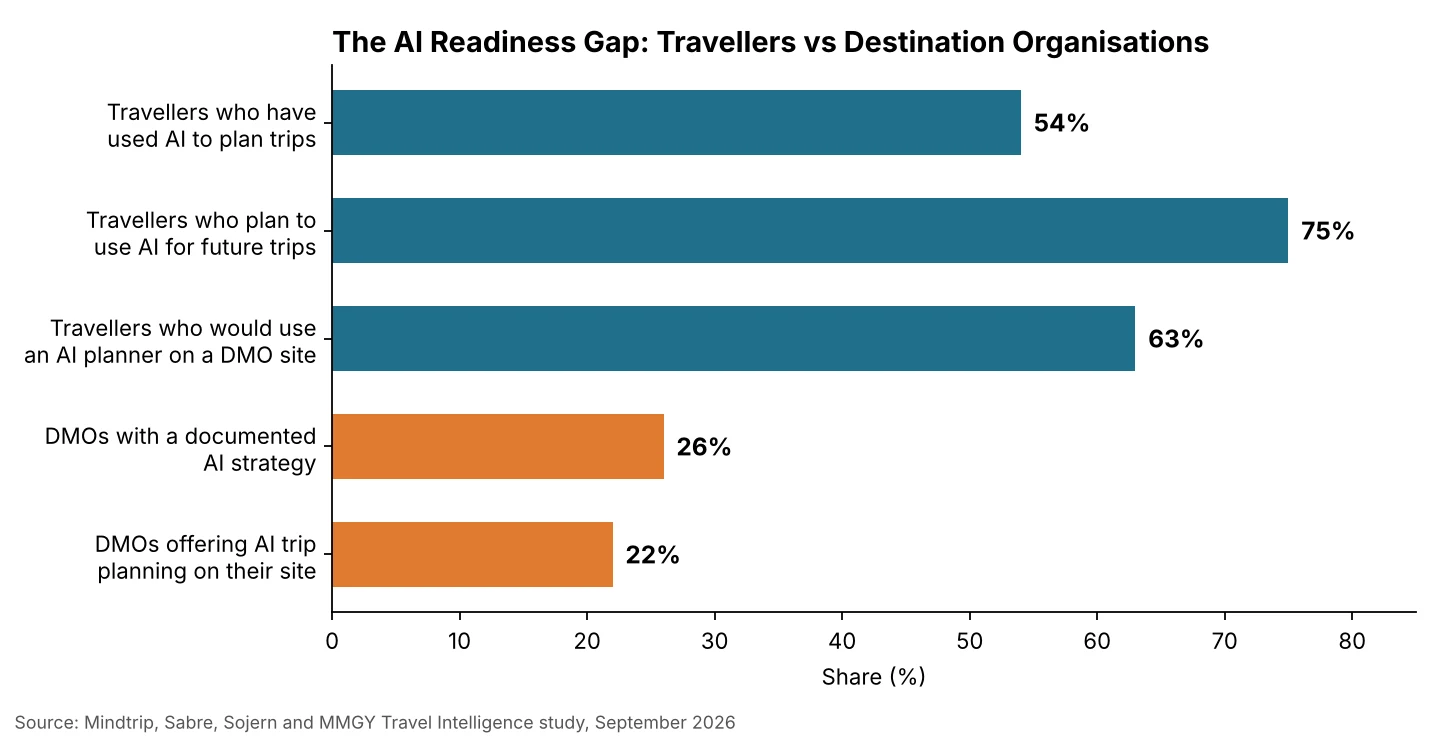
The gap is clear. Travellers already expect AI-ready help, while most destination organisations are still planning for it.
The Three Pillars: Search Demand, Useful Content and Partner Visibility
Strong destination marketing online rests on three pillars that feed each other. Treat them as one workflow and each makes the others stronger.
1. Start with Search Demand
Search demand shows what travellers actually want to know, and when. Use keyword research to map queries by trip stage: inspiration (“weekend getaways from Delhi”), planning (“best time to visit Coorg”) and on-trip (“rainy day things to do in Munnar”). Combine Google Trends, Search Console and partner enquiry data to spot when demand starts building, which is often several weeks before peak season.
2. Build Useful Content Around That Demand
Google’s guidance on helpful, people-first content rewards pages that show real experience and expertise. For destinations, that means itineraries tested by locals, seasonal guides, transport tips, accessibility details and honest event information.
A clear content marketing plan turns each demand cluster into one hub page supported by focused articles.
3. Give Partners Real Visibility
Hotels, restaurants, tour operators and attractions are the destination’s product. Featuring them in structured listings, itineraries and event pages adds depth that a generic travel blog cannot match. It also creates natural links and mentions across the local ecosystem, which helps both the DMO and its partners rank.
How the Pillars Work Together
| Pillar | What the DMO Does | What Partners Add | Visibility Outcome |
| Search demand | Maps seasonal and intent-based queries | Share booking and enquiry trends | Content goes live before demand peaks |
| Useful content | Builds hubs, itineraries and guides | Supply offers, photos and local tips | Pages cited in Google and AI answers |
| Partner visibility | Runs listings, event calendars and co-op campaigns | Keep listings accurate and link back | Stronger local authority and referrals |
| Measurement | Tracks rankings, AI mentions and referrals | Report bookings from DMO traffic | Clear proof of value for funders |
How to Coordinate a Destination Content Strategy
Create a Shared Content Calendar
Put festivals, school holidays, shoulder seasons, events and partner offers into one calendar. Invite partners each quarter to submit packages and dates, then publish supporting content ahead of demand rather than after it.
Set Listing Standards for Partners
Every partner listing should carry the same core details: name, address, phone, hours, photos, accessibility information and a booking link. Consistent data strengthens maps and local SEO for the whole destination, and it stops travellers from landing on closed or outdated businesses.
Structure Content for AI Search and LLMs
Use clear headings, short answer-first paragraphs, FAQ blocks and factual tables. Add structured data such as TouristDestination, Event and LocalBusiness schema. LLMs tend to cite pages that state facts plainly and are backed by other trusted sources.
Our guide on using AI for SEO explains how to build this without losing your local voice.
Measure Visibility Beyond Sessions
Track rankings for priority clusters, brand mentions in AI answers, partner click-outs and newsletter sign-ups. Tools like the Website Impact Calculator from Destinations International and Tourism Economics help connect DMO website traffic to local economic impact, which is the language funders understand.
Expert Insight: Across White Hat SEO Guru’s tourism work, the biggest wins rarely come from writing more. They come from merging thin, overlapping pages into one authoritative guide per topic, then letting partners enrich it with live offers and local tips. One strong “best time to visit” hub with current event data will usually outperform twenty short seasonal posts.
Pro Tip: Ask partners to link to the relevant DMO guide from their own websites and booking confirmation emails. It is the most natural link building a destination can earn, and it signals clearly to Google and AI systems who the official source is. Our guide to marketing strategies for tourism has more ideas for partner campaigns.
Common Mistakes to Avoid
- Writing for the board, not the traveller. Campaign slogans rarely match how people actually search.
- Copying partner content. Rewritten hotel descriptions add nothing. Add context, comparisons and local insight instead.
- Ignoring off-season demand. Shoulder-season queries are less competitive and help spread visitor flow across the year.
- Letting listings go stale. Wrong hours or closed businesses damage trust with travellers and search engines alike.
- Measuring traffic alone. A site with fewer sessions but more AI citations and partner referrals may be performing better.
Partner with White Hat SEO Guru for Destination Marketing
Building visibility for a tourism location takes more than a new website or a seasonal campaign. Search demand, content, partner listings and AI visibility all need to move together, and most destination teams are stretched thin.
Our team helps tourism boards, regional bureaus and destination partners build search-led content plans, partner listing systems and AI search visibility. Every plan comes with clear reporting that boards, partners and funders can understand.
Ready to Make Your Destination Easier to Find?
Frequently Asked Questions
What is destination marketing online?
It is the work a destination organisation does to build visibility for a place across search engines, AI assistants, maps, social media and partner websites, with the goal of attracting visitors and supporting local businesses.
How is a DMO different from a hotel or OTA in search?
Hotels and OTAs sell specific products. A DMO represents the whole destination, so it can publish neutral, in-depth guides and feature many partners, which makes it a strong candidate to be cited as the official source.
How can destination organisations appear in AI answers?
Publish clear, factual content that answers common traveller questions, use structured data, keep partner information accurate and earn mentions from trusted sites. AI tools favour sources that are consistent and well corroborated.
Why should DMOs feature local partners?
Partners are what visitors actually book and experience. Featuring them adds depth and freshness to DMO content, builds natural links and helps keep visitor spending inside the local economy.
How do DMOs find what travellers are searching for?
Use keyword research tools, Google Trends, Search Console data and partner booking or enquiry trends. Grouping queries by trip stage shows what content to create and when to publish it.
How should a DMO measure online marketing success?
Look beyond sessions. Track rankings for priority topics, mentions in AI answers, partner referrals, newsletter sign-ups and, where possible, estimated visitor spend linked to website activity.

Mandeep Singh
Mandeep Singh is the Founder and CEO of White Hat SEO Guru. Mandeep Singh manages White Hat’s digital strategy, bringing years of SEO marketing expertise. Since 2005, he has guided businesses like hotels, resorts, and restaurants to strengthen their online presence, attract more guests, and achieve measurable growth through smart, proven digital solutions.


