Table of Contents
Objective:
To help food truck owners get found by nearby customers, tell them where the truck is every day, and turn first-time buyers into regulars using simple, low-cost digital marketing.
It is 12:10 on a Tuesday. Your truck is parked outside an office block, the grill is hot, and a hungry crowd is scrolling their phones. Someone types “tacos near me open now,” sees three trucks on the map and taps the one with fresh photos, a posted location and a 4.8 rating. If that truck is not yours, the lunch rush walks right past you. That gap is exactly what food truck digital marketing closes.
Fact: BrightLocal’s 2026 Consumer Search Behavior survey found that 52% of consumers start their latest local search on Google Search, and 73% of local searches begin on a mobile device. IBISWorld counts 88,353 food truck businesses in the US in 2026, so almost every busy corner already has competition.
Food trucks face a problem that restaurants do not. You move. Your hours change with the weather, your location changes with the day, and your customers cannot walk past a sign to find you. Digital marketing fixes that, but only if the basics are set up in the right order.
This guide shows you how to build local awareness first, then keep those customers coming back. You will see what to set up, what to post, how to collect repeat customers and how to measure it all, without a big budget or a marketing team.
Want a Food Truck Marketing Plan That Fills Your Line?
Key Takeaways
- Food truck digital marketing is the use of local search, social media, messaging and reviews to help nearby customers find your truck, trust it and come back.
- Your Google Business Profile and a fast mobile page do more work than any ad, so fix them first.
- Post your location 24 hours ahead and again on the day. Customers visit what they can find.
- Repeat visits come from an owned list (SMS or email), a simple loyalty offer and fast review replies.
- Track calls, direction requests and redeemed offers, not just followers.
What Is Food Truck Digital Marketing?
Food truck digital marketing is the practice of using local search, social media, email, SMS and online reviews to tell nearby customers where your truck is, what you serve and why they should come back. Because a truck changes location and hours, it depends on real-time updates far more than a fixed restaurant does. The core ideas are the same as in broader restaurant marketing strategies, but the daily rhythm is different.
| Factor | Restaurant | Food Truck |
| Location | Fixed address | Changes by day, event or season |
| Discovery | Walk-by traffic, maps, reviews | Maps, social posts, schedules, word of mouth |
| Hours | Stable and listed once | Updated often, sometimes hourly |
| Repeat visits | Habit and proximity | Needs reminders and a reason to follow you |
| Top digital priority | Reservations and menu SEO | Location clarity and real-time updates |
How Local Customers Search
Before you spend a dollar, look at how people choose where to eat. Reviews, mobile search and Google dominate, and AI tools are now part of the mix.
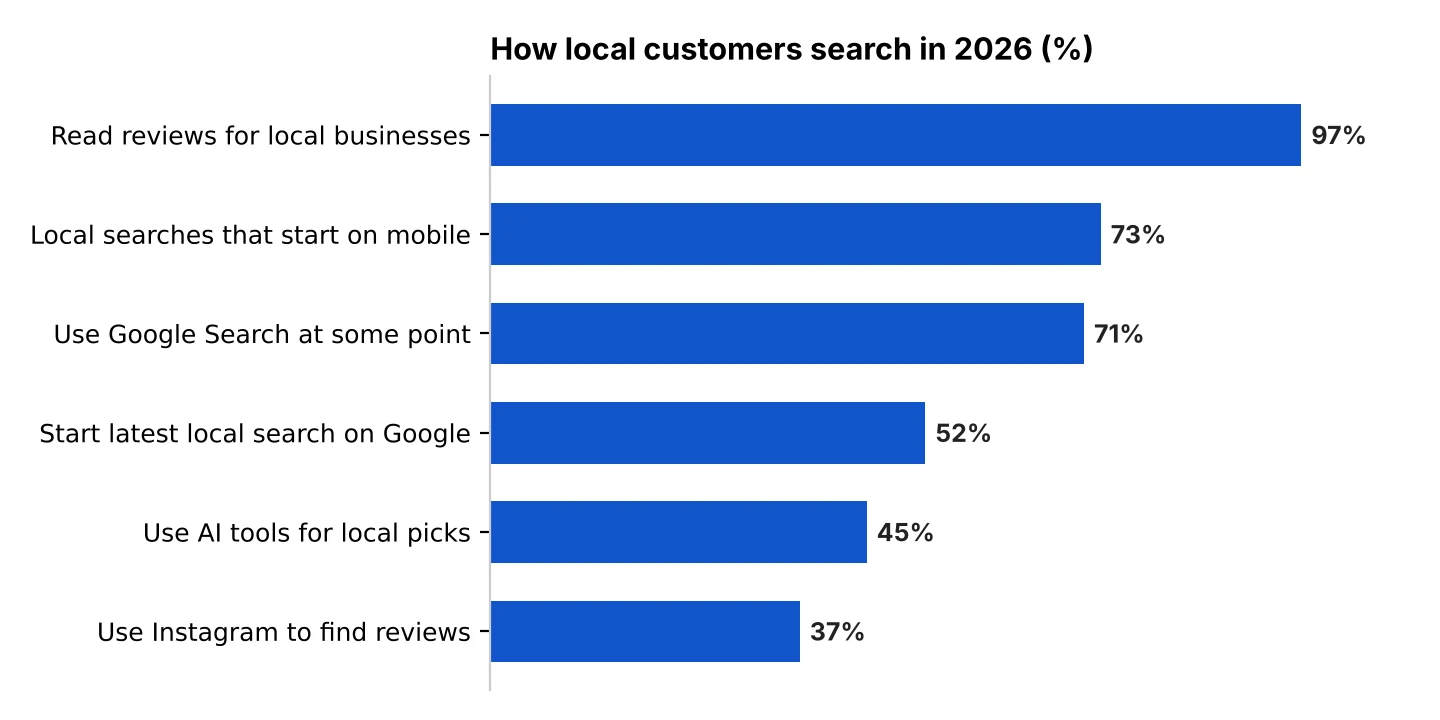
Source: BrightLocal Consumer Search Behavior and Local Consumer Review Survey, 2026. Percentages use different bases (consumers or local searches), so read them as direction, not one total.
Step 1: Build Your Local Foundation
Awareness only works if people who find you can trust what they see. Start with three assets you control.
Optimize Your Google Business Profile
Your profile is often the first thing a hungry stranger sees, so treat it like your storefront.
- Pick the closest primary category and add secondary ones for your cuisine.
- Follow Google’s current guidelines for mobile businesses when you set your address or service area.
- Post weekly updates with today’s location, specials and event dates.
- Add fresh photos of the truck, the food and the line. Google’s own playbooks, summarized by Whitespark, report that businesses with photos get 42% more direction requests.
- Link your menu, catering form and ordering page.
Did You Know? Customers are 2.7 times more likely to consider a business reputable when it has a complete Business Profile on Google Search and Maps (Google, via BrightLocal).
Keep One Fast, Mobile-First Page
You do not need a ten-page site. You need one page that loads quickly on a phone and shows the menu, this week’s schedule, a catering request form and a signup box. Slow pages lose hungry visitors, so check your page speed and keep photos compressed.
Get the Local SEO Basics Right
Use the same business name, phone number and website everywhere: Google, Yelp, Facebook, Apple Maps and delivery apps. Then target the phrases locals actually type, such as “[cuisine] food truck near me” or “food truck catering in [your city].” A simple keyword research pass will show you which ones are worth a page.
For the full playbook, read our guide to local SEO.
If you also run a fixed kitchen or café, our guide to local SEO for restaurants covers the extra steps.
Step 2: Create Local Awareness with Social and Content
Social media is your moving billboard. The goal is not to go viral. It is to be the truck people see three times before lunch. About 37% of US consumers use Instagram and 29% use TikTok to find local business reviews (BrightLocal, 2026), so these two matter.
| Channel | Best Use | Suggested Rhythm | Main Goal |
| Location Stories, menu photos, short Reels | Stories on every service day, 2 to 3 Reels a week | Daily visibility | |
| TikTok | Prep clips, sauce reveals, line shots | 2 to 3 short videos a week | New local reach |
| Events, local groups, schedule posts | Event page per big stop | Event crowds | |
| Google Business Profile | Location and special offer posts | Weekly | Map and search clicks |
| SMS or email | Truck alerts and member offers | 1 to 2 messages a week | Repeat visits |
Content That Works for Trucks
- The location reveal: post where you will be 24 hours ahead, then again one hour before opening.
- Behind the grill: short clips of prep, sauces and the first order of the day.
- Menu drops: a limited item creates a reason to come this week, not someday.
- Customer features: repost photos from happy customers and tag them. Treat it as free proof.
- Local partners: cross-post with breweries, offices, gyms and event organizers who host you.
If you want a deeper plan for consistent posting, our guide to content marketing covers how to build a repeatable calendar.
Step 3: Turn First Visits into Repeat Visits
Awareness fills the line once. Retention fills it every week. The cheapest customer you will ever get is the one who already bought from you.
| Tactic | How to Set It Up | Effort | What to Track |
| QR code signup | Print a QR code on the window and receipts that leads to an SMS or email form | Low | New subscribers per week |
| Digital punch card | Offer a free item after a set number of visits | Low | Redemption rate |
| Truck alerts | Send a short text with today’s spot and hours | Low | Clicks and visits |
| Pre-orders | Let office crowds order ahead for a pickup window | Medium | Pre-order share of sales |
| Member-only specials | Share one secret menu item with subscribers | Low | Offer redemptions |
Build an Owned List
Followers belong to the platform. Your list belongs to you. Offer a small perk, such as a free topping, in exchange for a phone number or email, and always get clear opt-in consent with an easy way to unsubscribe. Then use the list for what only a truck needs: “We are at Main Street until 2 PM.”
Keep the Loyalty Offer Simple
If a customer needs more than ten seconds to understand your rewards, it is too complicated. “Buy nine, get the tenth free” is clear. So is “Check in three Fridays, get a free side.”
Reviews and Reputation
About 97% of consumers read reviews for local businesses (BrightLocal, 2026), and a truck with no recent reviews looks risky. Ask at the window, use a QR code that links straight to your review page, and answer every review within two days, good or bad. Keep replies calm, factual and short. For a closer look, see our guide on online reputation management for restaurants.
Paid Ads on a Small Budget
Ads are useful once your profile, page and tracking are working. Run location-targeted campaigns around your regular stops, and switch on a short radius campaign for event days or new menu launches. Keep the daily budget small, send people to the right page and track calls and direction requests. Our overview of Google Ads for restaurants covers campaign setup in more detail.
Getting Found in AI Search
AI tools are becoming a local discovery channel. BrightLocal’s 2026 survey found that 45% of consumers use ChatGPT or other generative AI tools for local business recommendations. To show up, keep your name, cuisine, schedule and service area consistent across the web. Add a short FAQ to your site that answers questions such as “Do you cater?” and “Where are you parked today?” Encourage reviews that mention specific dishes, since AI tools often pull from review language. If you want to use AI for research and planning, see how to use AI for SEO without losing your own voice.
Your 30-Day Action Plan
| Week | Focus | Key Tasks |
| Week 1 | Foundation | Claim and complete your Google Business Profile, fix name and phone details everywhere, launch a one-page mobile site |
| Week 2 | Awareness | Start daily location Stories, post three short videos, partner with one local business or event |
| Week 3 | Retention | Add QR codes to the window and receipts, launch a simple loyalty offer, send your first truck alert |
| Week 4 | Reputation and review | Ask for reviews at pickup, reply to every review, check your numbers and keep what worked |
What to Measure
| Metric | Where to Find It | Why It Matters |
| Direction requests and calls | Google Business Profile insights | Shows real intent to visit |
| Profile views | Google Business Profile insights | Shows local visibility |
| List growth | SMS or email platform | Shows your owned audience |
| Offer redemptions | POS or punch card | Shows repeat behavior |
| Review count and rating | Google, Yelp, Facebook | Shows trust over time |
Expert Insight: Based on working with restaurants and hospitality brands since 2005, the trucks that grow fastest are rarely the ones with the best photos. They are the ones that are predictable. When customers know you are at the same spot every Tuesday and Thursday and that you will post if it changes, they plan their lunch around you. Consistency beats creativity in the first six months.
Pro Tip: Treat your best-performing stop like a mini flagship. Post about it weekly, add it as a recurring event on Facebook and mention it in your Google Business Profile updates. A reliable stop builds a reliable crowd.
Common Mistakes to Avoid
- Posting the location too late. Customers cannot plan around a truck that appears an hour before lunch.
- Chasing followers instead of a list. A platform change can erase your reach overnight. A phone number cannot be taken away.
- Ignoring reviews. Silence reads as not caring, and 97% of consumers are reading them.
- Using different details on each platform. Mismatched hours and names confuse customers and search engines alike.
- Running ads before the basics are ready. Paid traffic to a weak profile or a slow page wastes money.
If you want to see how these pieces fit into a bigger plan, start with our digital marketing guide.
For the wider food and hospitality picture, our hospitality marketing guide shows how trucks, restaurants and venues compete for the same local diners.
Partner with White Hat SEO Guru for Food Truck Marketing
Running a truck is a full-time job. Setting up local search, social media, reviews and tracking on top of it is hard to keep up with. White Hat SEO Guru helps food and hospitality brands get found, get chosen and get repeat business through clear, measurable strategies.
As a dedicated hospitality marketing partner since 2005, we understand local intent, seasonal demand and how customers now search across Google and AI platforms. We build a food truck digital marketing plan around your route, your menu and your budget, and we report on results you can understand.
Ready to Fill Your Line Every Day?
Frequently Asked Questions
What is food truck digital marketing?
It is the use of local search, social media, email, SMS and online reviews to help nearby customers find a food truck, trust it and return. It focuses on real-time location updates because a truck moves daily.
What is the best way to promote a food truck locally?
Start with a complete Google Business Profile, post your location 24 hours ahead on Instagram and Facebook, and partner with nearby offices, breweries and event organizers. These steps reach people who are close enough to visit today.
How do I get repeat customers for my food truck?
Build an owned list through a QR code, send short truck alerts, and offer a simple loyalty reward such as a free item after a set number of visits. Replying to reviews also keeps customers engaged.
Which social media platform is best for food trucks?
Instagram is usually the strongest starting point because of Stories, Reels and location tags. Add TikTok for short prep videos and Facebook for event pages and local groups.
Do food trucks need a website?
Yes, but it can be one fast page. Include your menu, weekly schedule, catering request form and a signup box. It gives you something to link from every profile and a place to collect leads.
How much should a food truck spend on digital marketing?
There is no fixed rule. Many owners start with free tools like Google Business Profile and social posting, then add a small local ad budget once tracking is in place. Scale the spend only after you can see what drives visits.
How long does it take to see results?
Social posts and Google Business Profile updates can bring visits within days. Local search rankings and a strong review base usually take two to three months of steady effort.

Mandeep Singh
Mandeep Singh is the Founder and CEO of White Hat SEO Guru. Mandeep Singh manages White Hat’s digital strategy, bringing years of SEO marketing expertise. Since 2005, he has guided businesses like hotels, resorts, and restaurants to strengthen their online presence, attract more guests, and achieve measurable growth through smart, proven digital solutions.